
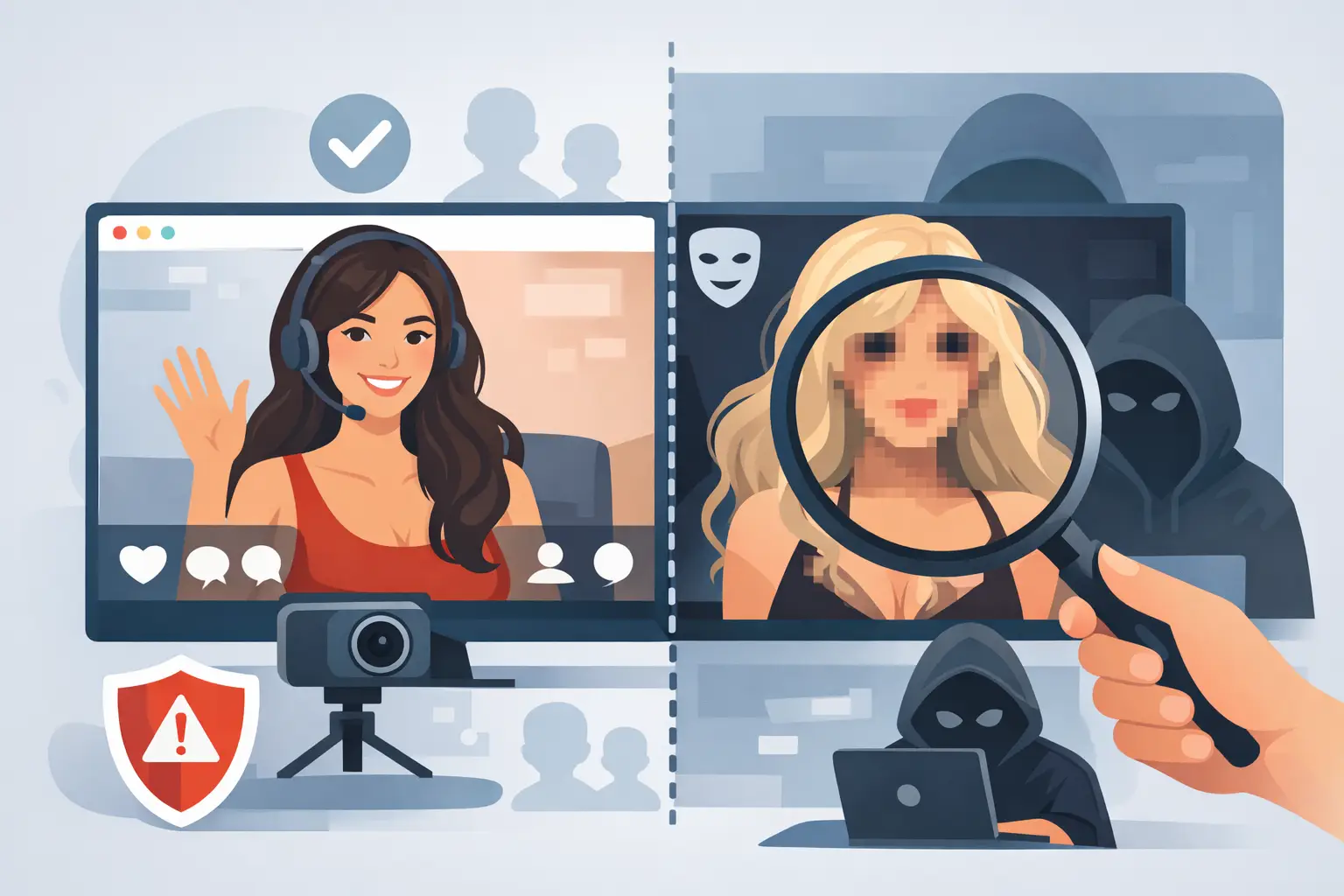
The fastest way to waste tokens is to mistake a loop, a bot, or a low-effort scam profile for a real live performer. If you want to know how to spot fake performers, stop looking at the thumbnail first and start looking at behavior. Real cam shows feel responsive, imperfect, and human. Fake ones usually feel polished in the wrong places and empty where it counts.
That matters even more on crowded platforms where hundreds of rooms compete for attention at the same time. A fake profile does not always mean an outright scam. Sometimes it is a prerecorded stream passed off as live. Sometimes it is a chat assistant pretending to be the model. Sometimes it is a profile built to farm tips without delivering anything close to an authentic session. The result is the same – you spend time and money on a room that is not giving you what you came for.
How to spot fake performers before you spend
The easiest mistake is assuming high production quality equals authenticity. In cam, that is not how it works. Some of the best real performers run excellent setups with pro lighting, smooth video, and strong audio. Others look more casual. Quality alone proves nothing. What matters is whether the performer reacts in real time, manages the room naturally, and behaves like someone actually present.
Start with the room itself. Watch before tipping. A real performer usually shifts attention between the camera, chat, private requests, and her own pacing. There is natural variation. She adjusts posture, reads comments, reacts to usernames, and makes small corrections that are hard to fake. A suspicious room often repeats the same movements, the same facial expressions, or the same canned chat patterns for too long.
If you enter a room and the performer seems to ignore obvious public chat for an extended period while generic flirty messages keep appearing, slow down. That can signal automation, outsourced moderation, or a model who is technically live but barely engaged. Not every quiet room is fake, but the gap between viewer interaction and performer response tells you a lot.
Watch for delayed or unnatural reactions
One of the clearest red flags is timing. Ask something simple and harmless in public chat. Mention a visible detail, request a small wave, or comment on something happening on screen. In a real room, you usually get some kind of acknowledgment if the model is actively working the chat. It might be immediate, delayed by traffic, or skipped if the room is busy, but the response should make sense.
What does not make sense is a model supposedly reading chat while answering with lines that do not match the question. The same goes for reactions that come too perfectly on loop. If every smile, hair flip, and camera glance happens on a suspicious cycle, you may be watching recycled footage or a heavily scripted performance layer.
This is where trusted networks tend to separate themselves. On major platforms like Chaturbate, Stripchat, LiveJasmin, ImLive, BongaCams, and Camsoda, there are still weak rooms and occasional bad actors, but the better-known sites generally make it easier to assess room activity, tip menus, and audience behavior in context. That does not remove risk. It just gives you better signals.
Profile clues that expose fake performers
A profile can tell you a lot before the show even starts. If the bio is ultra-generic, filled with broken English that does not match the claimed location, or padded with repetitive bait phrases, treat it as a warning sign, not a deal breaker. The issue is not imperfect writing. Plenty of legitimate performers are international, and not everyone writes polished copy. The issue is when the entire profile feels mass-produced.
Look at the media and stats together. A brand-new account with extremely polished promo images, inflated room numbers, and no real profile personality deserves extra caution. So does an account with endless promises of private exclusivity but no clear boundaries, no menu structure, and no visible pattern of real audience engagement.
Reviews, badges, and platform verification markers can help, but they should never be your only filter. Verification shows that a platform has checked some identity or compliance boxes. It does not guarantee that every minute of every room is equally authentic or worth your tokens. Smart users treat verification as one signal, not the final answer.
The room economy gives away a lot
Fake or misleading performers often reveal themselves through how they handle money. If the room pushes constant tipping with vague rewards, watch out. Real performers usually make the transaction clear. They set goals, list menu items, explain private options, or establish what a tip gets you. Even if the show is playful or spontaneous, the value exchange is usually understandable.
A bad room tends to stay blurry on purpose. You get repeated pressure to tip now, unlock now, or go private now, but very little confidence about what actually happens next. That kind of fog is not an accident. It is a conversion tactic aimed at impatient viewers.
There is also a trade-off here. Some top earners are less chatty because they can be. A high-traffic model may not respond to every message, and that alone does not mean the room is fake. The key question is whether the room still behaves like a live environment with clear audience influence. Popular does not mean fake. Empty and evasive is the more dangerous mix.
How to spot fake performers in private upsells
Private chat is where mistakes get expensive. A room can look decent in public and still become a disappointment once you pay for one-on-one time. Before going private, pay attention to how the performer handles custom requests in public conversation. Do you get direct answers, clear limits, and signs of personal control over the session? Or do you get generic sales language that could have been pasted by anyone?
If every answer sounds interchangeable, you are probably dealing with a low-authenticity operation. The strongest real performers usually have a distinct style. They may be warm, bratty, dominant, playful, or highly polished, but the voice feels consistent. Fake chat support and scripted handlers tend to flatten personality into repetitive, broadly seductive text.
Another clue is pacing. In a real private, the interaction should shift around your requests, the performer’s comfort level, and the site’s features. When everything feels preplanned regardless of your input, you are not getting a live custom experience. You are getting a prepackaged funnel.
Technical perfection can be suspicious too
Users often assume lag, awkward camera moves, or occasional interruptions are bad signs. Sometimes they are. More often, they are signs of an actual live setup. Real shows have friction. The camera needs adjusting. A toy disconnects. The model laughs at something offscreen. Audio changes when she moves closer to the mic.
By contrast, a room that runs with eerie consistency for long stretches while showing no meaningful interaction can feel wrong for a reason. Perfect loops are easier to fake than messy reality. That does not mean every smooth broadcast is suspicious. Premium studios and experienced independent performers can deliver excellent production. The point is that polished video without live responsiveness is not enough.
The safest way to avoid fake performers
If your goal is better odds, not blind luck, stay on established cam networks with active moderation, real user traffic, and visible room dynamics. Then use a disciplined screening process. Watch for a few minutes. Test live responsiveness. Read the room economy. Check whether the profile has a believable identity and whether the performer acts like someone running a show, not just occupying a screen.
This is where an objective review mindset pays off. Instead of chasing the hottest thumbnail, compare what actually affects your experience: room activity, performer responsiveness, pricing clarity, stream quality, and the overall feel of the interaction. Top-rated platforms make this easier because there is enough traffic and structure to expose weak rooms faster.
It also helps to accept that authenticity is not binary. Some rooms are fully real but low effort. Some are professional and highly managed but still genuinely live. Some are not technically fake yet still poor value. If your standard is a responsive, live, worthwhile show, that broader lens matters more than arguing over labels.
The best move is simple. Treat every room like a quick review process before you commit tokens. If the performer reacts naturally, the pricing is clear, and the room feels alive, you are probably in the right place. If it feels scripted, evasive, or oddly mechanical, trust that instinct and move on – there is always a better room waiting.
Leave a Reply